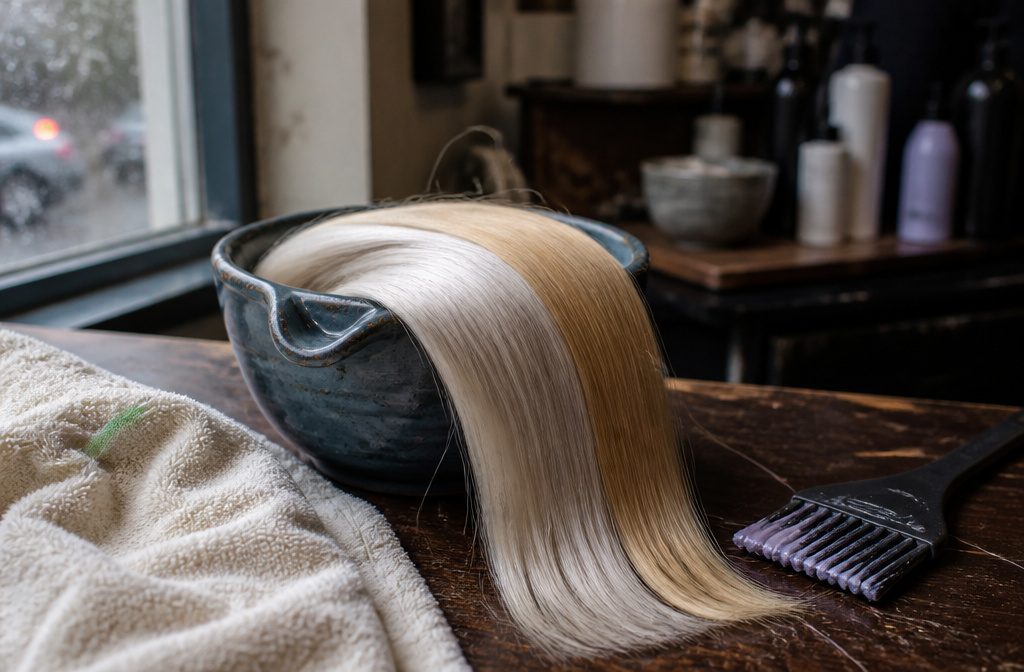
Toner is a pigment that deposits onto already-lightened hair to cancel unwanted yellow, orange or red tones: violet for yellow, blue for orange, green for red.
Toner cannot lift, so ammonia-based cream toner needs hair at level 9–10 first. A salon toner lasts about 20 shampoos; pigmented shampoo lasts about 2.
Identify the Unwanted Tone and What You Want Instead
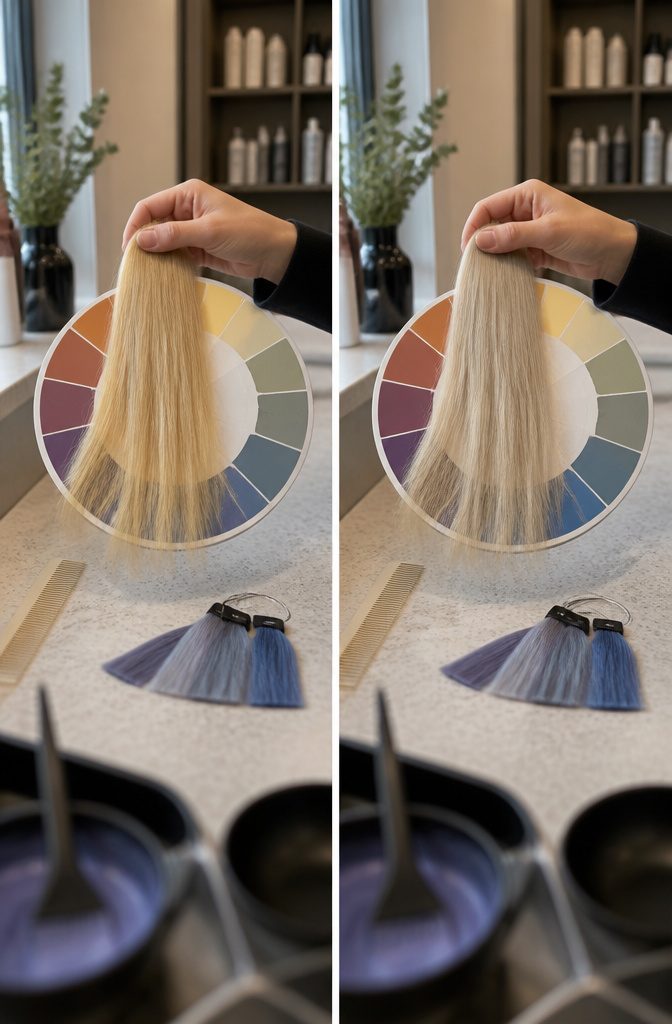
Look at the hair in daylight and name what you see: yellow, orange or red.
Each has an opposite on the color wheel that cancels it, so yellow answers to violet or purple pigment, orange to blue, and red to green.
The starting level decides which undertone shows. Hair lightened to a level 9 or 10 that still looks very yellow wants violet.
Hair sitting at a level 7 or 8 that looks brassy is usually yellow-orange, and there an ash, blue-based formula does more than violet alone, though a hint of violet also helps yellow-orange strands at level 7.
Set the goal before you buy anything. If you want a cool, even blonde, you only need to cancel the warmth you see, not add a new color on top of it.
Lighten to the Right Level Before You Tone
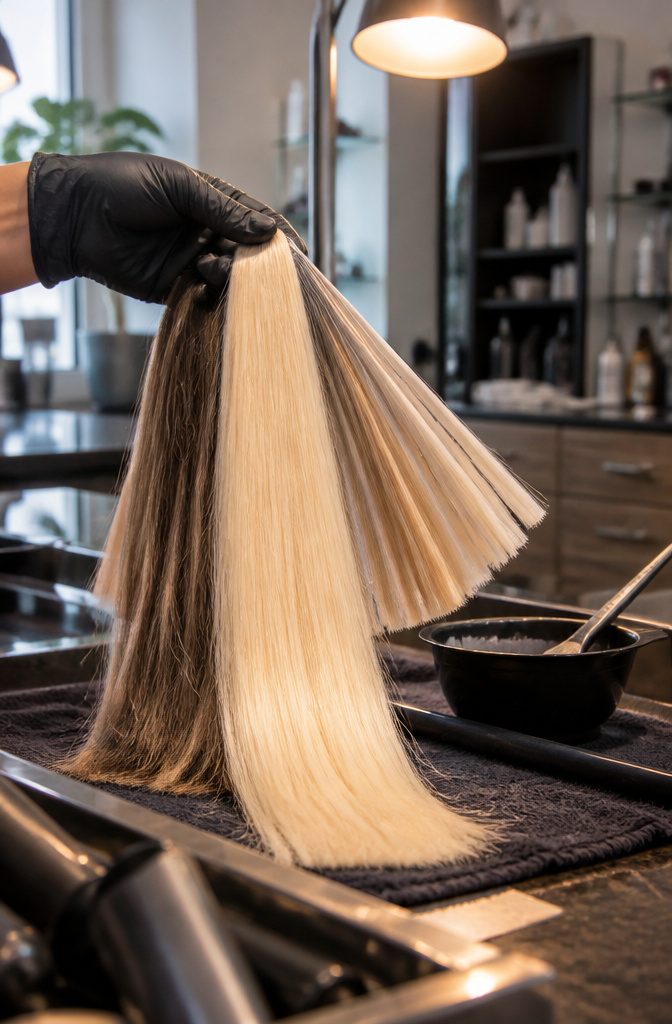
Toner works by depositing pigment onto hair that has already been lightened, and it cannot do the lifting itself. If you try to tone over dark or unbleached hair, the pigment has nowhere to settle and the result will disappoint.
The hair needs to be pre-lightened to at least level 9–10 before you apply a regular ammonia-based cream toner. That level gives the toner enough blank canvas to neutralize brass and deliver the cool or neutral blonde you are after.
Intense lifting toners offer a bit more flexibility because they have some lift built into the formula.
You can start applying those from level 6 or 7 onward and still get satisfactory results. Ammonia-free toners require at least level 7 to work properly.
If you skip the bleaching step or stop too early, the toner will not shift the underlying yellow or orange. It can only deposit color at the same level or darker, never lighter.
Choose the Toner Type and Formula
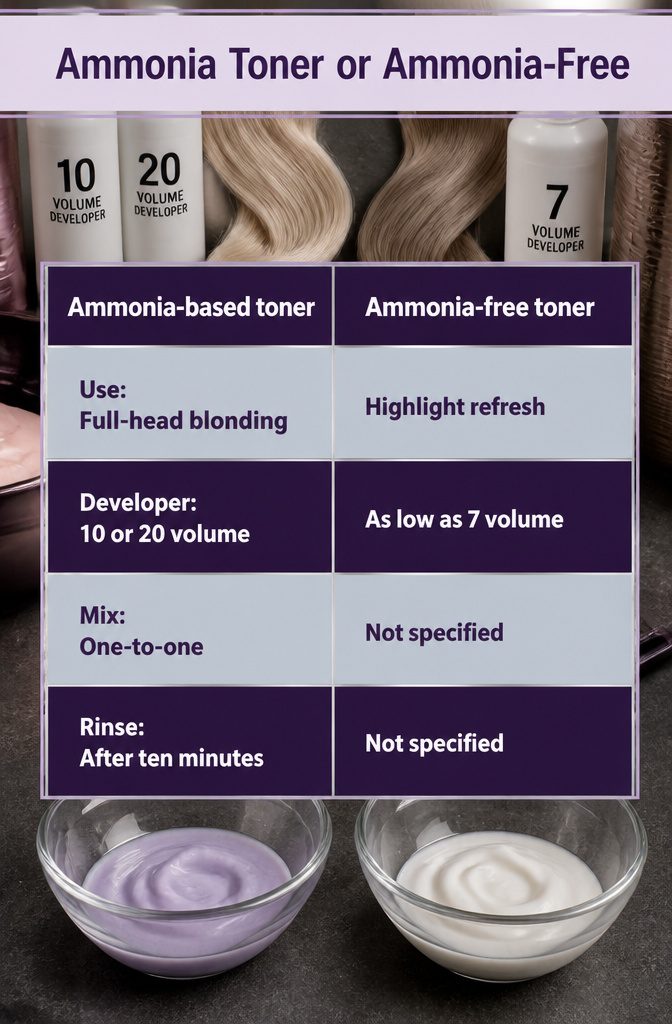
The choice starts with what needs to change. Ammonia-based toner is for full-head blonding or a strong shift when you lift the base, mixed one-to-one with developer at 10 or 20 volume and rinsed after ten minutes.
Ammonia-free versions work with developer as low as 7 volume, which I prefer when refreshing highlights without disturbing the base color underneath.
At-home toners, on the other hand, are designed for use (you guessed it) at home.
That distinction matters because salon toners use developer and last about 20 shampoos, while at-home pigmented shampoo or conditioner holds violet or blue pigment that neutralizes yellow or orange for about two washes.
Purple shampoo goes on when yellow tones show up, left for two to five minutes rather than at every wash. Color-depositing masks sit for five minutes root to tip after shampooing and refresh the tone with added moisture.
Gloss, glaze and toner overlap in what they do: all three mute or enhance tones while adding shine. Tone-down products take blonde darker without lifting first.
Mix and Prepare the Toner
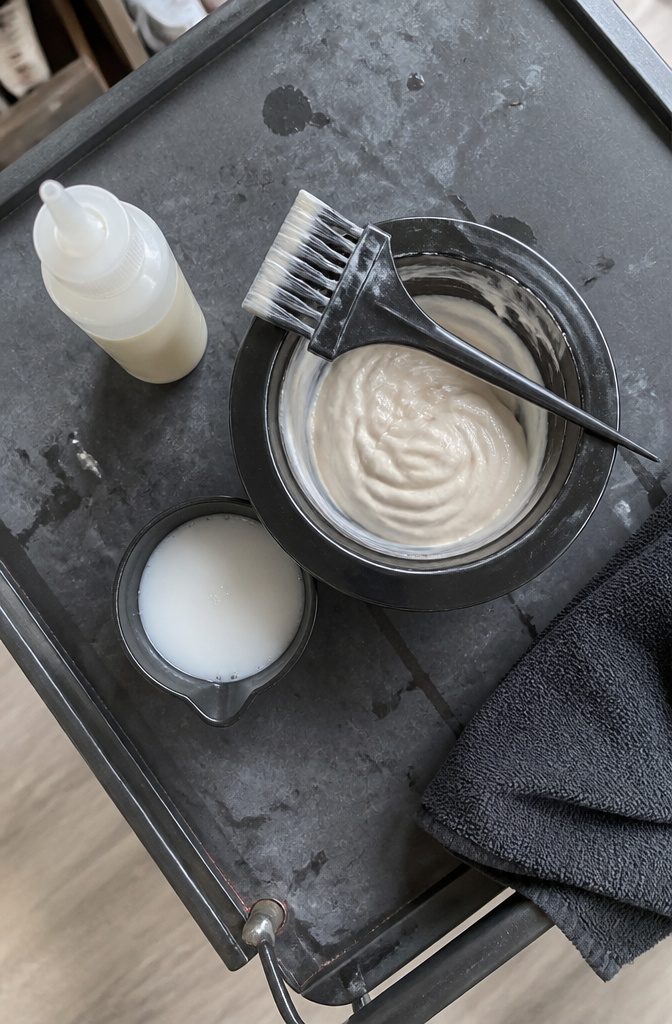
The ratio changes with the formula. Ammonia-based toners mix at 1 part toner to 2 parts developer, typically 20 Vol.
Ammonia-free toners take a simpler 1:1 ratio, and you can drop to 10 Vol or even 7 Vol for gentler processing. Tone-down color also runs 1:1 with developer.
I find it easier to remember the split by what the toner does: the stronger formulas need more developer to carry the pigment through lifted cuticles, while the gentler ones sit closer to the surface and need less push.
Mix in a plastic bowl if you’re applying with a brush, or use an applicator bottle if you plan to pour and work it through by hand.
Stir or shake until the texture goes smooth and creamy, with no streaks of unmixed product. Lumps will apply unevenly, and uneven application shows up fast on blonde.
Apply Thoroughly and Manage the Roots
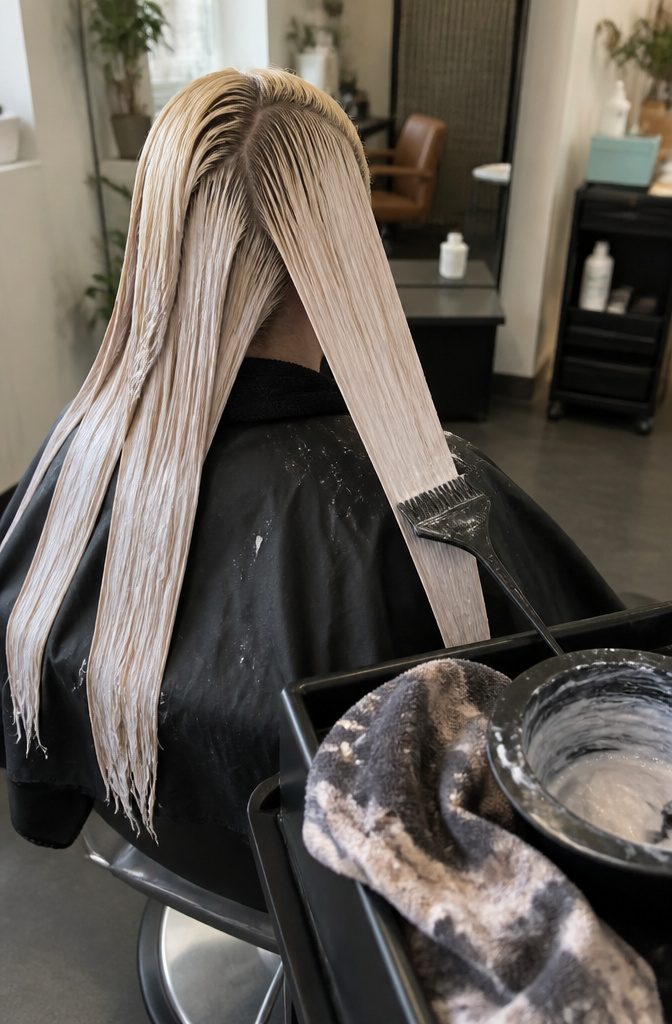
Once the toner is mixed, work quickly to saturate the hair really well with product.
Bleached or pre-lightened hair needs thorough coverage so every strand comes into contact with the formula, otherwise the result will be patchy. I always aim for speed and consistency here, because toner starts working the moment it hits the hair.
For very long hair that is consistently blonde from roots to tips, the root area should be applied last.
Return to it once the rest of the hair has been done. That part processes faster anyway due to the heat coming from the scalp, and applying it first risks over-toning the roots while the mid-lengths are still catching up.
Ammonia-free liquid toner can be poured onto dry or towel-dried hair and rubbed in vigorously. The rubbing motion helps distribute the product evenly without needing a brush for every inch, which saves time on longer hair.
Watch the Hair and Rinse at the Right Time
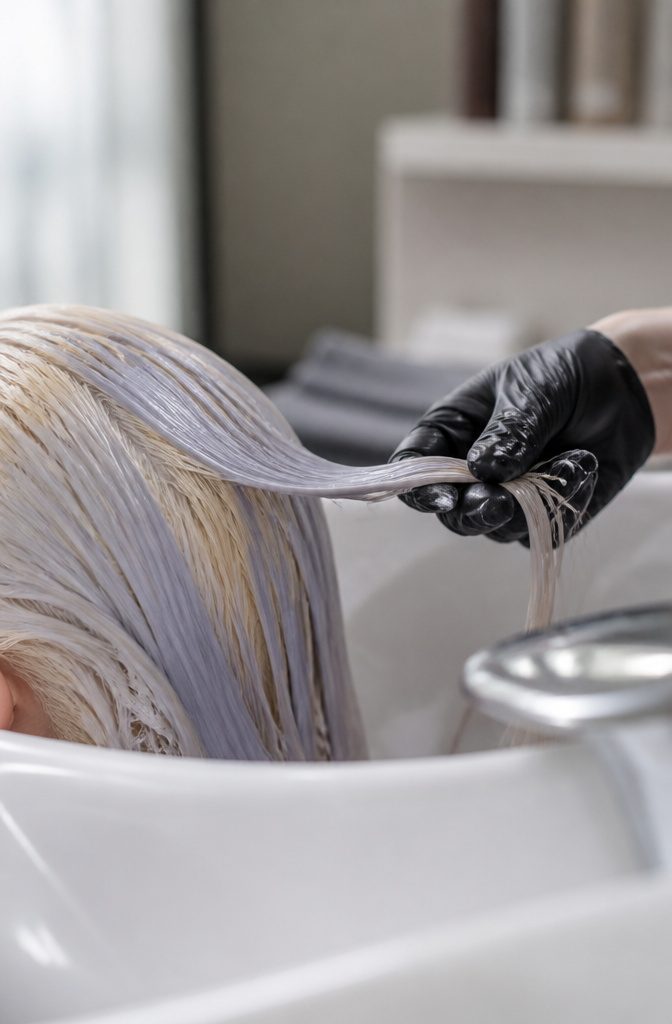
Ammonia-based toner needs watching, not a timer. Blue and gray pigments start to show on the hair as it processes, and that is normal: they are the pigments canceling the yellow.
Rinse when they appear. On very fine, well-lightened hair, 10–15 minutes can be enough, so I would start checking early rather than late.
Ammonia-free toner is simpler: rinse it after 10 minutes.
A purple mask sits around 10 minutes. Wella’s violet shampoo stays on for just 2–5 minutes, and I’d use it only on days when yellow shows, not every wash.
Wella’s color masks, such as Lilac Frost or Pearl Blonde, go on from root to tip for five minutes, then rinse.
Condition and Style After Toning
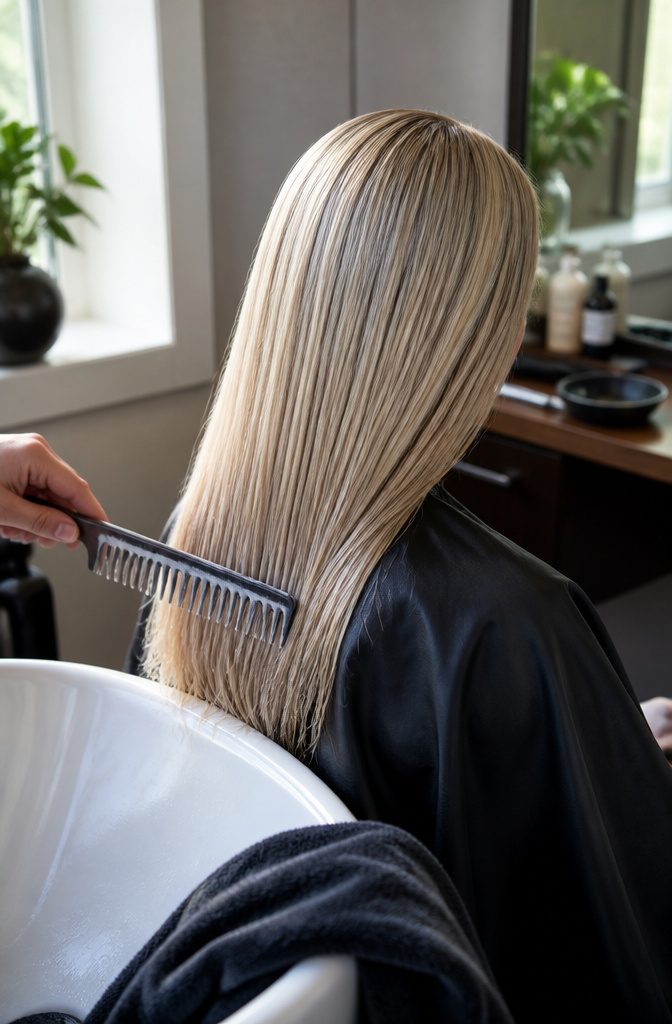
Rinse out every trace of toner before doing anything else.
Leftover product is the likeliest reason a tone dries patchy, so work through the roots, mid-lengths and ends, since the mix went onto every section. Then follow with a conditioner, comb it through gently, and rinse again.
Style the hair the way you normally would.
This is where toning pays off: the yellow and orange fade back, and the blonde looks shinier, healthier and more even than it did before. For many people that is the closest an at-home toner gets to a salon finish.
Keep the Tone Between Services
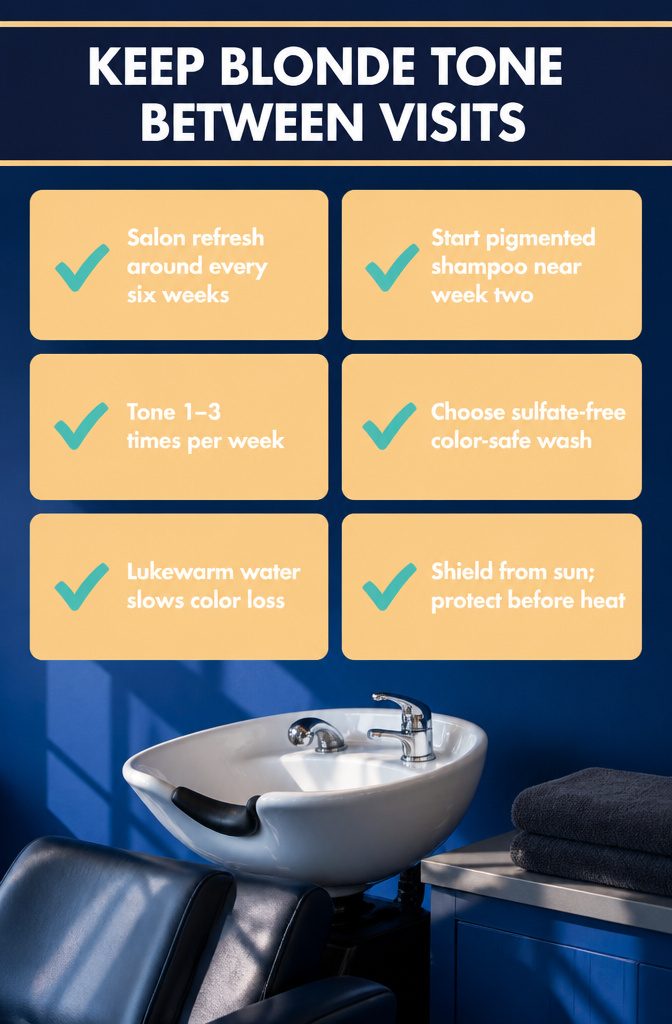
A salon toner lasts about 20 shampoos, while an at-home pigmented product lasts about 2. That gap sets the schedule:
- Book a salon refresh around every six weeks.
- Start a pigmented shampoo near the two-week mark, or when your blonde starts shifting tone.
- Use a toning shampoo or conditioner 1–3 times per week, and a color-safe, sulfate-free pair on the other days.
- Wash with lukewarm water. Hot water is an easy way to rinse color out faster.
- Wear a hat or head wrap in strong sun, because sun fades colored hair.
- Apply a heat protectant before any hot tool, and I’d turn the heat down for toned blonde.
Why Toner Cannot Replace Lightening
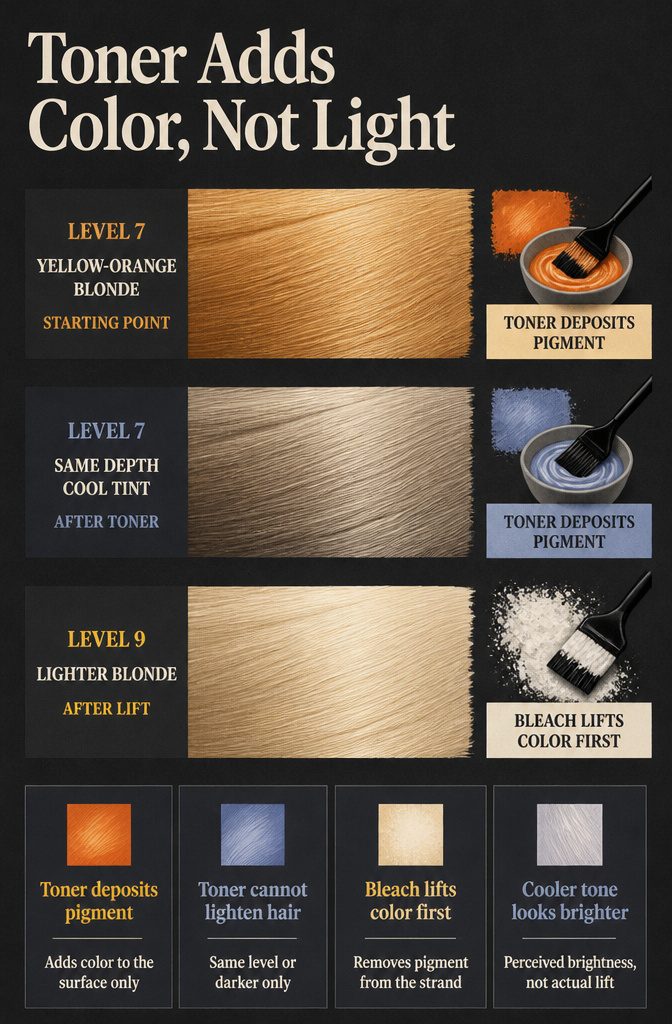
Toner works by depositing pigment, and pigment can only hold hair at its current level or push it darker.
Toner cannot lighten hair, so a yellow-orange blonde stays at that depth no matter how cool the formula is. Lightening is a separate step that has to come first.
Bleach lifts color out of the strand, and toner then corrects the tone that lifting leaves behind. Put toner on hair that is still too dark and you get the same depth with a tint.
Toned blonde often looks lighter, and I understand why people mistake that for lift. A cooler tone reads brighter, but the level underneath hasn’t changed.
Salon Toner Against At-Home Products
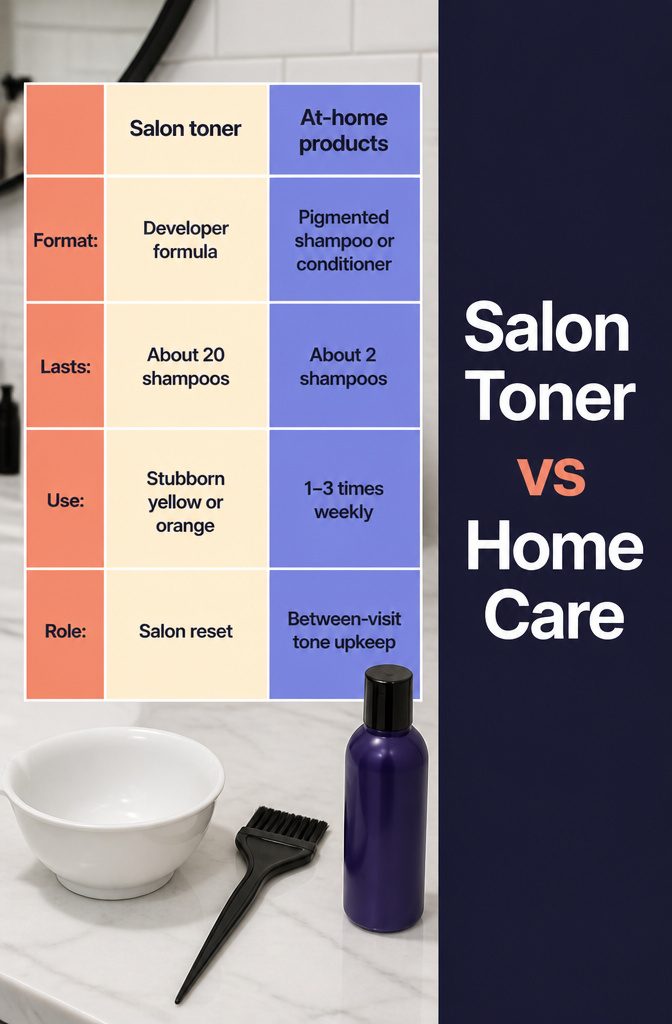
A salon toner is mixed with developer, and its pigment typically lasts about 20 shampoos.
That strength is why I’d send stubborn yellow or orange to a stylist first. The formula can also adjust the quality and color of the dye itself.
At-home toning comes as a pigmented shampoo or conditioner. Its small violet- or blue-based molecules neutralize yellow and orange, but they fade after about 2 shampoos, so plan on using one 1–3 times a week.
Salon for the reset, bottle for the stretch between visits: that pairing wins. Home products extend the life of a color without matching a salon’s staying power.
Pre-Toning Before a Bold or Warm Color
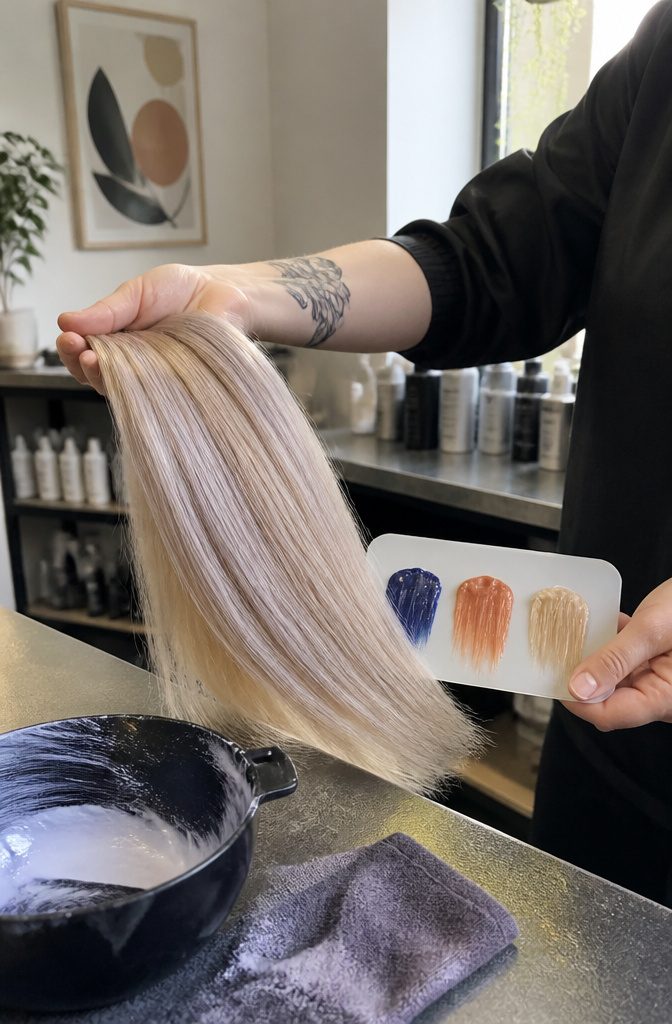
Pre-Toning Before a Bold or Warm Color
If you want marine blue hair or any cool, bold shade, pre-toning with a violet neutralizer can save you from a muddy green result.
Yellow underneath blue reads green, so I neutralize the base first with a violet toner before applying the fashion color.
The same logic applies when you’re working toward a caramel or golden blonde. Applying warm tones straight onto yellow can push the result too brassy, but balancing the base with a cool, violet-tinted blonde toner first keeps the warmth controlled.
Pre-toning also helps those rich blondes fade more gracefully over time, which matters if you want the color to soften rather than sour between sessions.
Going Darker With Tone-Down Products
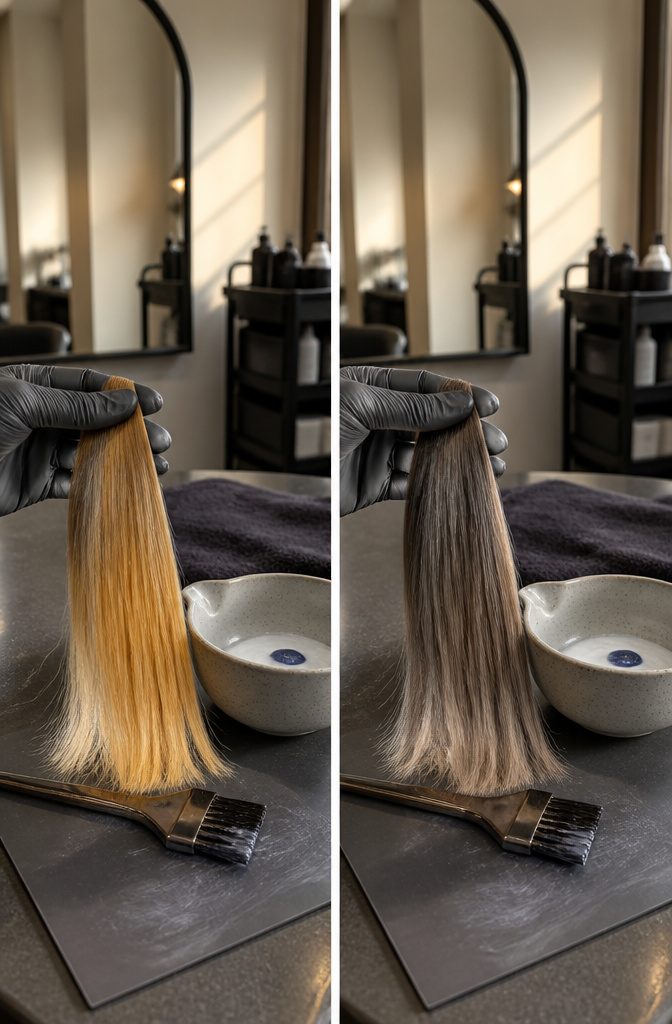
Going darker is a different move from a standard toner.
You drop one or two levels to a consistent brunette, and the added depth swallows the orange and yellow reflects. Blue-based and ash blue-based shades neutralize brassiness best, which is color theory doing the work.
Ugly Duckling’s range for this includes 8.1b Light Cold Ash Blonde, 7.1b Cold Ash Blonde, 6.1b Dark Cold Ash Blonde, Ash Blue Additive and Ash Grey Additive.
The additives get squeezed into an ash blonde color, and for a first try I’d use about an inch per tube of color.
They are extremely concentrated, and too much leaves hair overly dark and overly toned down. Start light, because you can add more next time but you can’t lift it back out.
What Can Go Wrong With Incorrect Use
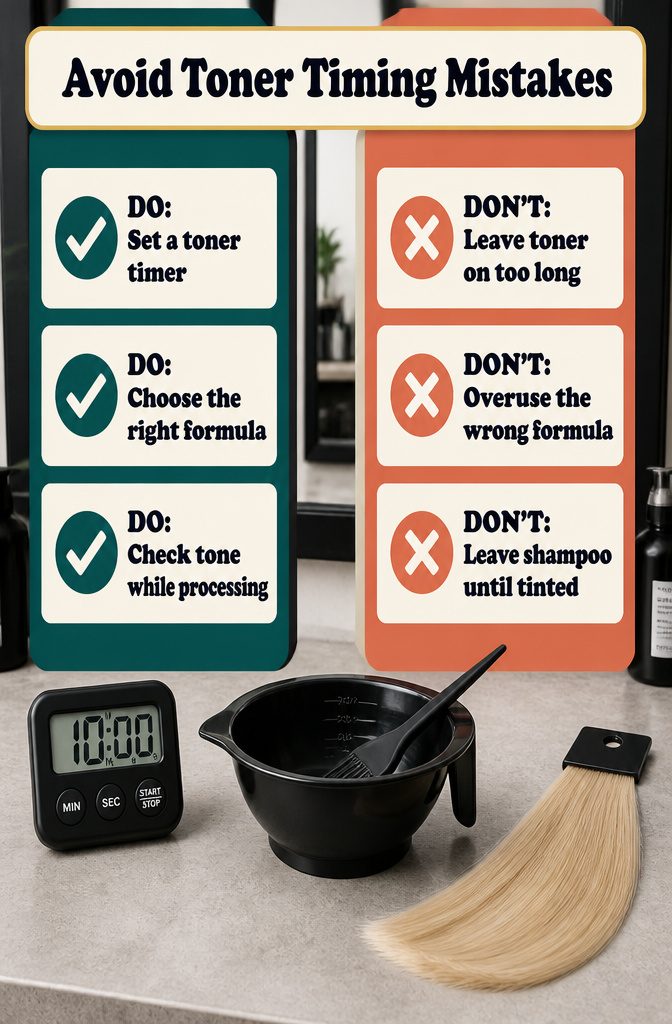
Toning goes wrong in three ways, and the clock is behind most of them:
- Hair left under toner too long can grab too dark or pick up too much of an unwanted undertone. Stylists set a timer for this reason, and I’d set one at home too.
- A drugstore formula used incorrectly can turn dry. Too much of the wrong one leaves hair feeling dry and flaky instead of shiny.
- A toning shampoo left in too long deposits excess pigment, so strands show a visible purple or blue tint instead of a clean blonde.
Professional toners are fairly nourishing, so frequency isn’t the worry. Timing and formula choice are.
Frequently Asked Questions
What is a hair toner?
A hair toner is a product that deposits pigment to correct unwanted yellow, orange, or other tones in color-treated hair, or to emphasize a desired tone.
It can take the form of a semi-permanent dye mixed with developer, a pigmented shampoo, a conditioner, or a tinted gloss. Toners work by neutralizing the undertones exposed during lightening or bleaching, giving you a cleaner, more customized blonde.
How do I use ammonia-based hair toners?
Mix 1 part toner with 2 parts developer (usually 20 Vol), then apply quickly and thoroughly to bleached or pre-lightened hair.
Watch the hair as it processes rather than relying on a timer. Rinse when blue and gray pigments appear on the strands, which can take 10–15 minutes for very fine, well-lightened hair.
What pre-lightening level is necessary for ammonia-based toners?
Hair needs to be pre-lightened to at least level 9–10 before applying a regular ammonia-based cream toner.
Intense lifting toners offer more flexibility and can work from level 6 or 7 onward because they have some lift built into the formula. Without proper lightening first, the toner has no blank canvas to neutralize brass.
How do I use ammonia-free toners?
Mix 1 part toner with 1 part developer (as low as 7 or 10 Vol), then pour the mixture onto dry or towel-dried hair and rub it in thoroughly.
Leave it on for 10 minutes, then rinse. The gentler formula sits closer to the surface and needs less push than ammonia-based versions.
How do I know which toner to use?
Look at the hair in daylight and name the unwanted tone: yellow, orange, or red. Use the opposite on the color wheel to cancel it: violet or purple pigment for yellow, blue for orange, green for red.
The starting level also decides which undertone shows, so hair at level 9 or 10 that looks very yellow wants violet, while hair at level 7 or 8 that looks brassy usually needs an ash, blue-based formula.
Why does hair turn yellow?
Yellow can come from natural undertones exposed during the lightening process, or from faded, brassy blonde color.
The tone can range from an orange level 7 to a very pale level 10. Skipping the color care routine or styling without heat protection also causes blonde to fade yellow over time.
Can pre-toning counteract yellow hair?
Yes, pre-toning with a violet neutralizer creates a cleaner base for cool or warm colors and helps prevent yellow from changing the final result.
If you want marine blue hair, applying the shade straight onto yellow can turn strands green, but pre-toning with violet gives you a flawless base. Pre-toning also helps warm blondes fade more gracefully between sessions.
Will toning hair lighten my color?
No, toner cannot lighten hair. It works by depositing pigment, which can only hold hair at its current level or push it darker.
Bleach lifts color out of the strand first, and toner then corrects the tone that lifting leaves behind. Toned blonde often looks lighter because a cooler tone reads brighter, but the level underneath has not changed.
How often should I tone my hair?
A salon toner lasts about 20 shampoos, so book a refresh around every 6 weeks. At-home pigmented shampoo or conditioner lasts about 2 shampoos, so start using one near the 2-week mark or when your blonde starts shifting tone.
Use a toning shampoo or conditioner 1–3 times per week, and a color-safe, sulfate-free pair on the other days.
Are there side effects to hair toner?
Leaving toner on too long can make hair grab too dark or pick up too much of an unwanted undertone.
A drugstore formula used incorrectly can turn hair dry and flaky instead of shiny. A toning shampoo left in too long deposits excess pigment, so strands show a visible purple or blue tint instead of a clean blonde.
Is toner the same as purple shampoo?
No, they are different products. Purple shampoo is an at-home toning product that holds violet pigment to neutralize yellow for about 2 washes, left on for 2–5 minutes rather than at every wash.
Salon toner is mixed with developer, deposits pigment onto pre-lightened hair, and typically lasts about 20 shampoos. Both neutralize unwanted tones, but salon toner offers stronger, longer-lasting results.
Should I shampoo before toning my hair?
No, apply toner to dry or towel-dried hair that has been bleached or pre-lightened, not freshly shampooed wet hair.
Mix the toner with developer, then apply it quickly and thoroughly to every section. Rinse out every trace of toner after processing, then follow with a conditioner, comb it through gently, and rinse again.